
Last Updated: November 10, 2026
Quick Summary
Use art for emotional regulation with a five-step process: name your feeling and rate its intensity out of ten, take five slow breaths to settle your body, then make art for 15 to 40 minutes without judging the result. Afterward, look at what you made, name what shifted, and journal your before and after numbers.
- Match the activity to your intensity: containment first for high distress, expression second.
- At intensity eight or above, extend the relaxation step and start with a grounding activity.
- Stop making and move to Step 4 early if your intensity climbs above your starting number.
- Keep a dedicated journal to track prompts, moods, and whether your after number trends down over weeks.
- For trauma-sensitive use, favour structured prompts like mandalas over free association.
Table of Contents
- Why Art Works When Words Stall
- What You'll Need Before You Start
- A Five-Step Process for Using Art for Emotional Regulation
- Choosing an Activity by Emotional Intensity and Goal
- Art Therapy Exercises for Anxiety You Can Do at Home
- Mindful Art Activities for Adults Who Have Never Made Art
- The Benefits of Art for Mental Health, and What the Evidence Actually Shows
- When to Stop, and When to Seek More Support
- Frequently Asked Questions
Why Art Works When Words Stall
When a feeling is too big for words, a crayon can often reach it.
The process is simple. You make something. Then you look at it and notice what changed inside you.
Researchers studying emotion processing in art therapy describe sessions built around exactly this rhythm: a short talk to build trust, a brief relaxation exercise, then a long stretch of making the REPAT study on emotion processing in art therapy.
Here is what most guides get wrong. They treat art as a distraction. It is not.
Below, we break down a repeatable five-step process you can use today, plus how to pick the right activity for your emotional intensity.
What You'll Need Before You Start
You need less than you think. A few basic supplies and a willingness to make something ugly will do.
Gather these:
- Paper, any size. Printer paper works fine.
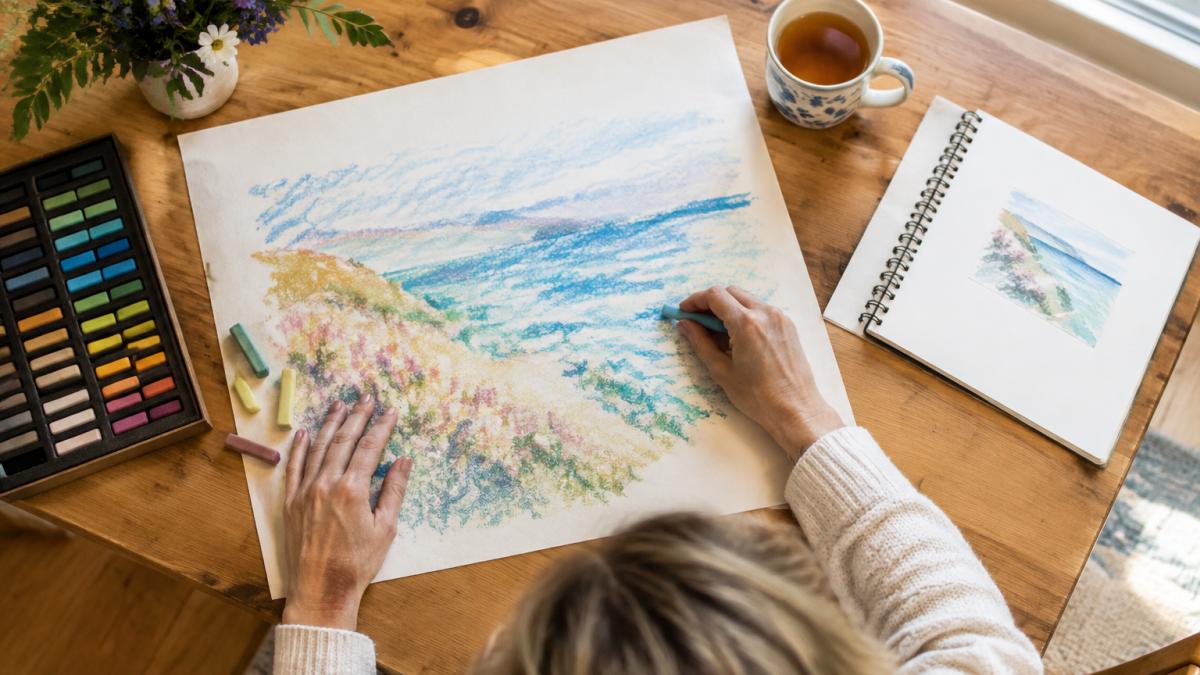
- Something to make marks with: pastels, pencils, paint, or textas.
- A flat surface and 20 to 40 minutes.
- A glass of water and a quiet space.
Skip the pressure to buy "proper" art supplies. A cheap set of oil pastels and a sketchbook will carry you further than expensive materials you are afraid to touch.
One insider tip: keep a dedicated journal for this work. A spiral notebook with dotted pages can give you a private place to track moods, prompts, and small shifts over time.
A Five-Step Process for Using Art for Emotional Regulation
This is our core method. It takes about an hour, start to finish, and you can run it any time a feeling needs somewhere to go.
Step 1: Run a 60-Second Emotional Check-In
Stop and name what you feel. Use an emotion wheel or a simple scale from one to ten for intensity.
Ask yourself three things:
- What is the feeling? Angry, sad, anxious, flat?
- How strong is it right now, out of ten?
- Where do I feel it in my body?
Write the answers down. This is your baseline, and you will compare against it later. Naming a feeling can sometimes ease its intensity, which is why the check-in is a useful first step.
Step 2: Settle Your Body Before You Pick Up a Brush
Take five slow breaths. Roll your shoulders. Shake out your hands.
A short relaxation pause lowers the alarm response enough that you can create without flooding. The REPAT researchers built a relaxation step into their sessions for this reason Frontiers in Psychology coverage of creative arts and emotion. If your intensity is already at eight or above, extend this step to two or three minutes and consider starting with a grounding activity, pressing your feet into the floor, naming five things you can see, before any mark-making.
Step 3: Make for 15 to 40 Minutes Without Judging the Result
Set a timer and start. No planning, no fixing, no erasing.
Choose one prompt:
- Draw the feeling as weather.
- Paint the colour of your mood.
- Fill the page with the shape your body wants to make.
If the inner critic pipes up, note it and keep going. The point is expression, not a finished piece.
Watch out: if your intensity climbs above your starting number during this step, stop making and move to Step 4 early. Pushing through rising distress to finish a piece is the most common way self-guided art-making backfires.
Step 4: Look Back and Name What Shifted
When the timer ends, sit with your page. Ask:
- What do I notice in the image?
- Does the feeling have a different intensity now?
- What word comes to mind looking at this?
Say it out loud or jot it down. This is where emotional awareness grows. If the number has gone up rather than down, that is useful information too, it tells you this prompt or this intensity was too much for today, and you can choose a gentler activity next time.
Step 5: Close the Loop
Write one line in your journal: the before number, the after number, and one word for the image. That is your record. Do it again next time and patterns will surface, which prompts settle you, which times of day work, and whether the after number is trending down over weeks rather than in a single session.
Adapting the Process for Trauma-Sensitive Use
If strong feelings are connected to trauma, a few adjustments make the process safer. Keep the making short and contained rather than open-ended. Favour structured prompts, a mandala, a single continuous line, a colour swatch, over free association, because structure gives the nervous system something to hold onto. Keep the materials predictable and the space private. And treat any urge to stop as a valid signal rather than something to push past.
Choosing an Activity by Emotional Intensity and Goal
Match the activity to the feeling. High distress needs containment. Low mood needs gentle activation. The table below is a starting point, but the more useful skill is knowing how to choose when the number alone does not tell you what to do.
| Intensity | Goal | Best Activity | Time |
|---|---|---|---|
| 8-10 (overwhelmed) | Contain and ground | Finger painting, single-colour scribble | 10-15 min |
| 5-7 (agitated) | Release and process | Large-scale painting, clay or sculpture | 30-40 min |
| 3-4 (flat or low) | Gently activate | Collage, mandala drawing, pastels | 20-30 min |
| 1-2 (settled) | Reflect and build insight | Mood journal, emotion wheel sketch | 15 min |
Time
Three Questions That Pick the Activity for You
Before you reach for supplies, answer these:
- What do I want to happen? If the goal is to calm down, choose repetitive, contained work, mandalas, dots, single-colour filling. If the goal is to express something, choose expansive work, large paper, bold colour, clay. If the goal is to understand something, choose reflective work, journaling, emotion-wheel sketching, collage with words.
- How much capacity do I have? At high intensity, capacity is low. Pick something that cannot go wrong and needs no decisions: one colour, one page, one shape. At low intensity, you can handle more choice.
- What is the setting? A shared kitchen table calls for low-mess materials. A private room allows for larger, messier work.
A common pattern is that people pick expressive, large-scale activities when they are most overwhelmed, the opposite of what helps. Containment first, expression second, is the safer order.
Accessible and Low-Mess Alternatives
You do not need a studio. These options work for different abilities, materials, and settings:
- Low-mess: coloured pencils, oil pastels, dot markers, sticker collage, digital drawing on a tablet or phone.
- No-mess: a single continuous line drawn in the air with a finger, or tracing a shape on paper with a dry brush.
- Sensory-friendly: choose materials by texture, smooth pencils for some, soft clay for others, and keep the space quiet and predictable.
- Mobility-accessible: seated work at a table, larger grips on tools, or digital options that need only a finger.
For a deeper, guided option, our Open Palette Journey sacred flow sessions blend meditation, music, and mixed-media exploration. You can also read the benefits of sacred flow art sessions before you choose.

Art Therapy Exercises for Anxiety You Can Do at Home
Anxiety responds well to art that slows the body and occupies the hands.
1. The five-line breath drawing. Draw one line for each slow breath. Keep the line continuous.
2. Mandala drawing. Start with a small circle and build outward in repeating patterns.
3. Worry collage. Tear images and words from magazines that match the worry, then glue them into one shape.
These can be mindful art activities for adults that you can use when feeling overwhelmed.
Mindful Art Activities for Adults Who Have Never Made Art
You do not need experience. You need permission.
Start with activities that cannot go wrong:
- Finger painting with two colours
- A single continuous line across the page
- Rubbing textures with a soft pencil
- Filling a page with dots, one per breath
The creative process matters more than the product. Many people find that the first ten minutes feel awkward, then something loosens.
If you are drawn to a structured, immersive experience, our Holistic Integrated Creative Arts Therapy sessions offer 45 minutes of one-on-one guidance with all materials provided.

The Benefits of Art for Mental Health, and What the Evidence Actually Shows
The benefits of art for mental health are real, but they are not magic. Research on artistic creative activities suggests that making art can help regulate emotions, and a 2025 study linked artistic creativity with better emotion regulation and lower social anxiety research on artistic creativity and emotion regulation.
What the research does support:
- Art offers nonverbal expression when words fail.
- Making art can reduce tension and build self-awareness.
- Regular practice supports emotional wellbeing over time.
What it does not replace: professional therapy for trauma, severe anxiety, or crisis. Treat it as a complement, not a cure.
For readers navigating loss, our guide to creative arts therapy for grief goes deeper into this work.
When to Stop, and When to Seek More Support
Stop if the art-making leaves you more agitated, not less. That is a signal, not a failure.
Watch out: pushing through rising distress to "finish" a piece can flood you. If your intensity climbs above your starting number, put the materials down and ground yourself.
Seek extra support if:
- Strong feelings linger for hours after you stop
- You feel worse after several sessions
- The feelings connect to trauma or crisis
Art therapy is guided by a practitioner and differs from self-guided art-making.
Feeling stuck with a feeling that will not shift?
Frequently Asked Questions
How does art therapy help with emotional regulation?
Art gives feelings a physical form before you have the words for them. Many people find it helpful to settle first, create second, and reflect third.
How do I start using art for self-regulation if I am not an artist?
Skip the idea that you need skill. Pick one medium you can hold comfortably, such as pastels, a watercolour set or a pencil, and give yourself 15 minutes. Start with a single mark and let the next mark answer it. There is no composition to get right. If a blank page stops you, fold the paper into quarters and fill one square at a time. Many people find a guided session easier for their first attempt because someone else holds the structure while you focus on the feeling.
Are there specific art materials best for calming the nervous system?
Match the material to the state you are in. When you feel agitated, slow, repetitive actions help: shading with a soft pencil, blending pastels with your fingers, or filling in a mandala. When you feel flat or shut down, faster and messier materials work better, such as finger painting or large brush strokes on big paper. Clay and collage sit in the middle because they occupy your hands without demanding precision. Keep one low-mess option on hand for days when setting up feels like too much effort.
Can art be used as a coping mechanism for anxiety?
It can be part of a coping plan, but it is not a replacement for professional care. Artistic creative activities may help regulate emotions in several ways. The practical version: use art early, when anxiety is rising rather than at its peak, and pair it with a body-based step such as slow breathing first. If anxiety is affecting your daily life, speak to your GP about a mental health treatment plan.
