
Table of Contents
- What's the Difference Between an Art Print and an Original Painting?
- Art Prints vs Original Paintings: Key Visual Differences
- How to Tell If a Painting Is Original: A Practical Inspection Checklist
- Fine Art Print Quality: Canvas Prints vs Paper Prints
- How Printing Methods Affect How Closely Reproductions Resemble Originals
- How to Make Prints of Original Paintings: The Reproduction Process
- Viewing Distance, Lighting, and Framing: How They Change What You See
- Can a Print Actually Look Like an Original? The Honest Answer
- Frequently Asked Questions
Last Updated: October 12, 2026
What's the Difference Between an Art Print and an Original Painting?
Do art prints look like original paintings? The short answer is: high-quality art prints come remarkably close, but they're not identical. The difference lies in how each is created and what happens to the surface over time.
At Pure Art Moments, we work with artist Pam Colla to create fine art prints that preserve the depth and texture of original hand-painted studio work. Understanding what separates a print from an original helps you make an informed choice about which suits your space and budget.

Original paintings: hand-created and one-of-a-kind
An original painting is a one-of-a-kind artwork created directly by an artist's hand. The artist applies paint, ink, or other media to a surface, usually canvas or paper, layer by layer.
Original paintings have physical depth. The paint sits on the surface in raised brushstrokes and textured layers. When you run your hand across an original, you feel the actual paint.
Originals are typically more expensive because they're irreplaceable. They increase in value as the artist's reputation grows. Collectors often view originals as investments.
Art prints: reproductions made from originals
An art print is a reproduction of an original artwork. A high-resolution scan or photograph captures the original painting.
Prints are mass-produced (or made on demand). Multiple copies come from the same original image. The signature on a print is usually part of the reproduced image, not hand-signed by the artist.
Prints cost far less than originals. They're affordable for renters, people decorating multiple rooms, or those who love an artwork but can't justify the investment. Prints make original art accessible to more people.
Art Prints vs Original Paintings: Key Visual Differences
The visual gap between a quality art print and an original painting has shrunk dramatically over the past decade. Modern printing technology captures colour, detail, and even texture in ways that older methods couldn't.
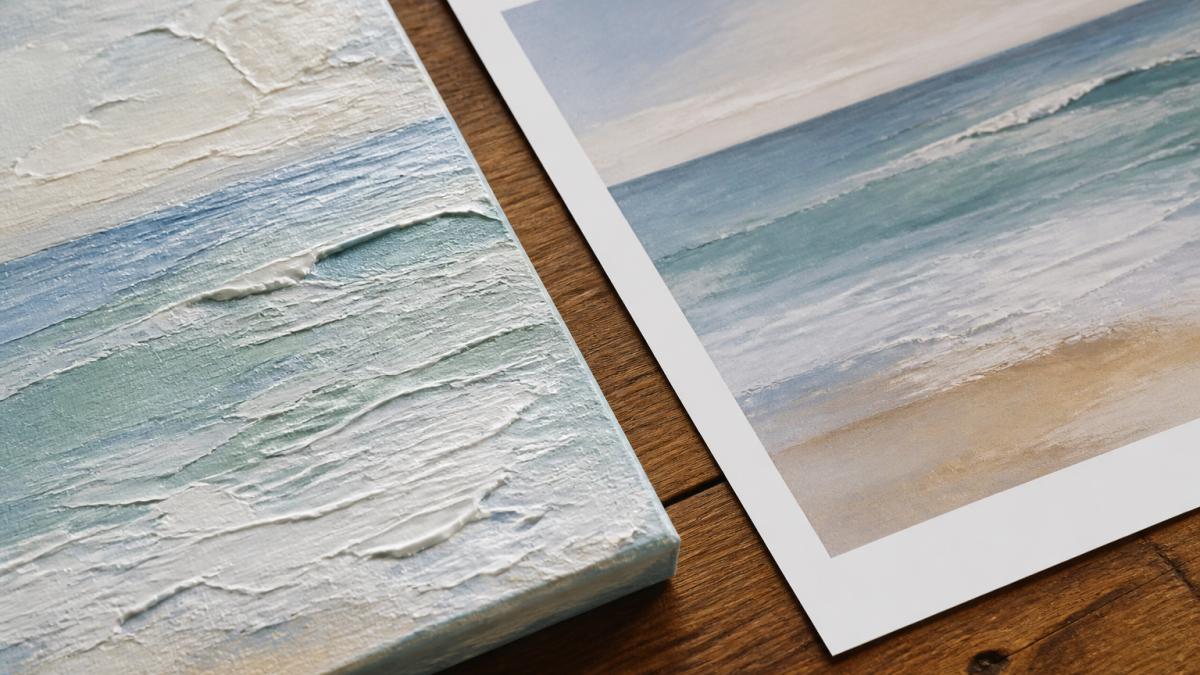
Surface texture and brushwork
The most obvious difference is what you feel when you touch the artwork. An original painting has physical texture. Brushstrokes create raised areas. Paint sits in layers. The surface is uneven.
A print is flat. Even if the paper or canvas has some texture, it comes from the substrate itself, not from applied paint.
That said, high-quality canvas prints can create an illusion of brushwork. When a textured painting is reproduced onto textured canvas, the result mimics the original's surface.

Colour depth and ink application
Originals often have richer colour depth because multiple layers of paint create visual complexity. Light bounces through semi-transparent layers. Colours shift and glow depending on the angle and lighting.
Prints reproduce colour through ink dots or dye sublimation. Modern printing methods are excellent at capturing colour accuracy, but they work differently than paint.
Pure Art Moments uses museum-quality matte paper sourced from Japan with high opacity and brightness ratings. This gives prints depth and longevity that cheaper printing doesn't achieve.
Signature and authenticity markers
Original paintings usually carry a hand-signed signature. The artist physically writes their name into the paint. This signature is proof of authenticity.
Prints have a reproduced signature, it's part of the image. Limited-edition prints sometimes include a hand-signed certificate of authenticity or a small hand-written number indicating which print in the series it is. This adds authenticity but doesn't replace the hand-signed original.
How to Tell If a Painting Is Original: A Practical Inspection Checklist
Wondering whether you're looking at an original or a print? Here's how to inspect artwork up close.
What to look for up close
Start by examining the surface from different angles and lighting:
- Run your hand across the surface. Feel for raised brushstrokes, paint texture, and dimensional variation. Originals have physical depth. Prints are flat (even textured canvas prints feel smooth compared to paint).
- Look at the edges. Original paintings often show paint on the sides of the canvas or the edges of the paper. Prints usually have clean, uniform edges because they're reproduced onto a flat substrate.
- Check the back. Originals show canvas weave or paper texture on the reverse. Prints show uniform backing material.
- Examine the signature. Is it hand-written into the paint, or is it printed as part of the image? Hand-signed signatures have ink depth and variation that printed signatures lack.
- Look for imperfections. Originals often have tiny variations, a slightly thicker area of paint, a colour variation where the artist blended two shades. Prints are uniform because they're reproduced from a single digital file.
- Inspect under bright light. Originals show paint texture and light reflection that varies across the surface. Prints show consistent ink coverage.
What photographs and online listings can't reveal
A photograph of artwork, even a high-resolution one, can't tell you whether it's an original or a print. Photos flatten the image. They remove texture and depth. An original painting photographed well can look like a print.
Online listings often don't specify whether you're buying an original or a print. Always ask.
The only reliable way to distinguish an original from a print is to see it in person and touch it.
Fine Art Print Quality: Canvas Prints vs Paper Prints
Not all art prints are created equal. The substrate you choose changes how the artwork looks and feels.
Canvas prints and raised texture
Canvas prints are reproduced onto canvas stretched over wooden stretcher bars. The result feels substantial and gallery-ready.
When a textured original painting is reproduced onto canvas, the effect is striking. The canvas weave mimics brushstrokes.
The downside: canvas prints cost more than paper prints. They're also heavier and require wall-mounting hardware.
Pure Art Moments offers canvas prints like the Wave Textured Painting Canvas Print and Colourful Flowers Textured Painting Canvas Print, hand-stretched over solid wood with fade-resistant ink.

Paper prints and matte finishes
Paper prints use archival-quality paper with a matte finish. Matte paper has no gloss, it doesn't reflect light the way glossy paper does. This creates a softer, more refined appearance.
Matte paper is ideal for detailed artwork because it doesn't create glare. The image appears to sit on the paper rather than behind glass.
Colours of Spring — Fine Art Print | Pure Art Moments →
The Colours of Spring, Fine Art Print from Pure Art Moments is printed on museum-quality matte paper sourced from Japan.
How Printing Methods Affect How Closely Reproductions Resemble Originals
The technology used to reproduce an artwork determines how closely the print resembles the original. Not all printing methods are equal.
Giclée printing and high-resolution scans
Giclée (pronounced "zhee-clay") is a fine art printing method that uses inkjet technology to spray tiny dots of archival ink onto paper or canvas. The process captures extraordinary detail and colour accuracy.
Giclée requires a high-resolution scan of the original artwork, typically 300 dpi (dots per inch) or higher. This scan captures every detail, every colour shift, every texture variation.
The result is a print that's visually nearly identical to the original from a distance.
Colour reproduction and archival quality
Colour reproduction depends on two factors: the quality of the scan and the quality of the ink.
A poor scan loses colour information. An inexpensive print uses non-archival inks that fade over time. A quality print uses archival-grade inks rated to last 100+ years without fading.
Pure Art Moments uses archival-quality printing to ensure prints maintain their colour and vibrancy. The combination of a high-resolution scan and archival inks creates reproductions that closely resemble originals and last for decades.
How to Make Prints of Original Paintings: The Reproduction Process
Understanding how an original becomes a print helps you appreciate what goes into high-quality reproduction.
From studio painting to digital image
The process begins in the studio. Artist Pam Colla creates an original hand-painted work on canvas. The painting is complete, textured, layered, full of colour and life.
Next, the original is professionally photographed or scanned. Professional photography captures the painting under controlled lighting to minimize glare and shadow. A high-resolution scan captures every detail and colour nuance. This digital file becomes the master image for all future reproductions.
Selecting the right paper or canvas substrate
Once the digital master exists, the next choice is substrate. Will the print go on paper or canvas? What finish, matte, satin, or glossy?
Paper prints suit detailed artwork and work well for framing. Canvas prints suit bold, textured originals and work well as standalone wall art. The substrate choice affects how the final print looks and feels.
Pure Art Moments offers both options. Choose based on your space, lighting, and personal preference.
Viewing Distance, Lighting, and Framing: How They Change What You See
Here's something most guides miss: how close you stand to an artwork changes what you perceive.
From across a room, a quality art print can look identical to an original.
Move closer, within a few feet, and the differences become apparent.
Lighting also matters. Harsh overhead light reveals the flatness of a print.
Framing changes perception too. A print in a gallery-quality frame looks more substantial and valuable.
Can a Print Actually Look Like an Original? The Honest Answer
Yes, but with caveats.
A high-quality print reproduced onto textured canvas from a high-resolution scan can look remarkably close to an original from a distance.
But a print will never be an original. It lacks the physical depth of paint. It lacks the hand-signed authenticity.
That doesn't make prints inferior, it makes them different. Prints are accessible. They're affordable.
The question isn't whether prints look like originals. It's whether prints deliver the beauty, inspiration, and personal connection you're seeking. For most people, the answer is yes.
Frequently Asked Questions
Can a print look like an original painting?
Yes, high-quality art prints can closely resemble original paintings when reproduced using professional methods like giclée printing on museum-grade materials. The resemblance depends on the printing technique, paper or canvas quality, and how faithfully the original artwork's colour and texture are captured. Fine art prints on textured canvas or premium matte paper can create an authentic appearance, though they won't have the raised brushstrokes of a hand-painted original when viewed up close.
How can you tell if a painting is original?
Inspect the artwork up close for raised brushstrokes, visible paint layers, and uneven texture across the surface. Original paintings show variation in paint application and often have a signature applied directly into the paint. Check the back for studio marks or artist information. Look for colour variations and imperfections that suggest hand-application. Online photographs and listings cannot reveal these tactile qualities, so viewing in person is essential for confirmation.
What is the difference between a fine art print and an original painting?
An original painting is hand-created by an artist, making each piece unique with individual brushwork, texture, and character. A fine art print is a high-quality reproduction of an original artwork, created using professional printing methods like giclée to transfer the image onto paper or canvas. While fine art prints preserve colour and detail faithfully, they lack the raised brushstrokes and physical paint layers of originals. Prints are more affordable and accessible, making art collecting possible for more people, though they don't hold the investment value or rarity of one-of-a-kind originals.
Can art prints reproduce brushstrokes and texture?
Canvas prints can approximate texture through the weave of the canvas and the ink application, creating a subtle tactile quality that mimics brushwork. Textured canvas prints using high-resolution scanning of original paintings come closest to replicating the appearance of raised brushstrokes. However, they cannot exactly reproduce hand-applied paint layers. Paper prints offer a flatter finish but can still convey the visual impression of brushwork through colour gradation and detail. Viewing distance matters: from across a room, a quality textured print can convincingly resemble an original painting.
Ready to bring gallery-quality art into your home? Explore Pure Art Moments' collection of fine art prints and canvas reproductions. Each piece is designed to inspire and elevate your space. Browse our coastal-inspired fine art collection to find the perfect artwork for your walls.