
Last Updated: November 2, 2026
Quick Summary
The top 5 art print sizes for small office spaces are 20 × 30 cm for narrow walls, 30 × 45 cm above a desk, 40 × 60 cm as a single statement print, 50 × 70 cm for a feature wall, and 60 × 90 cm to open up the room. Choose art print sizes that fill roughly 60 to 70 per cent of the usable wall width.
- A 30 × 45 cm print is the all-rounder size for hanging above a standard desk.
- Measure the wall width and take 60 to 70 per cent as your target artwork width, frame included.
- A mat adds 5 to 10 cm on every side, so factor it in before choosing a size.
- Keep the bottom of the frame 15 to 25 cm above the top of the monitor.
- A gallery wall in a small office works best with three prints, not nine.
Table of Contents
- Why Art Print Sizes Decide Whether a Small Office Feels Calm or Crowded
- The Five Art Print Sizes That Work in a Small Office
- How to Measure for Wall Art Before You Buy
- Matching Office Wall Art by Room Size
- Art Above Desk Size: Getting the Height and Width Right
- Gallery Wall Layout for a Small Office
- Choosing Your Print Size and Hanging It This Weekend
- Frequently Asked Questions
Why Art Print Sizes Decide Whether a Small Office Feels Calm or Crowded
Walk into a small office with a print that's too big for the wall, and you feel it before you can name it. The room closes in.
A common design rule of thumb is proportion: artwork that fills roughly 60 to 70 per cent of the available wall width, rather than the whole wall, tends to make even a compact study feel considered.
The Five Art Print Sizes That Work in a Small Office
These five sizes cover most small-office walls. Each has a clear job, and picking the wrong one for the job is a common mistake.
| Rank | Print Size | Best For | Wall Width Needed |
|---|---|---|---|
| 1 | 20 × 30 cm | Narrow walls, beside doors | 45-60 cm |
| 2 | 30 × 45 cm | Above a desk | 70-90 cm |
| 3 | 40 × 60 cm | A single statement wall | 90-110 cm |
| 4 | 50 × 70 cm | Feature wall behind a chair | 110-140 cm |
| 5 | 60 × 90 cm | The room-opening format | 140-180 cm |
1. 20 × 30 cm: The Narrow Wall Fix
Small format prints solve the wall nobody knows what to do with: the sliver beside a door, the strip between a window and a shelf. A 20 × 30 cm print sits comfortably in a space under 60 cm wide without crowding the frame.
Best for: rented offices and narrow wall gaps. Skip if: the wall is wider than your desk, because it will look lost.
2. 30 × 45 cm: The All-Rounder Above a Desk
If you buy one size and nothing else, buy this one. A 30 × 45 cm print fills the space above a standard desk without overpowering the person sitting under it. Hang it so the centre sits roughly at eye level when seated, and it becomes the calm focal point of the workspace.
3. 40 × 60 cm: The Single Statement Print
Medium format artwork earns its place on a wall with nothing else competing for attention. A 40 × 60 cm piece suits a blank wall behind a monitor or a reading chair, and it's the size where texture and brushwork start to read properly from across a room. The Point Lonsdale Rock Pools Sunset Fine Art Print, available in 16 sizes, is one option at this scale.
4. 50 × 70 cm: The Feature Wall Piece
Large format prints need a wall that can carry them. A 50 × 70 cm piece works when the wall is at least 110 cm wide and the furniture below it is substantial, a wide desk or a low shelf. Put it on a narrow wall and it will feel like it's pressing forward.
5. 60 × 90 cm: The Room-Opening Format
The largest format on this list makes a small office feel bigger, not smaller, provided the wall can take it. A 60 × 90 cm print needs a clear wall of 140 cm or more and a viewing distance of at least two metres, usually the wall opposite the desk.
How to Measure for Wall Art Before You Buy
Measure the wall width, then take 60 to 70 per cent of it. That figure is your target artwork width, including the frame. A 100 cm wall wants art around 60 to 70 cm wide.
Then check three things before you commit:
- Furniture width: artwork above a desk or shelf should be slightly narrower than the furniture, never wider.
- Viewing distance: you should be able to see the whole print without turning your head from where you sit.
- Frame and mat: a mat adds 5 to 10 cm on every side, so factor it into the total before you choose a size.
If you're about to buy a print and want the measured size to actually work once framed, our guide to framing tips for fine art prints covers the details that change the final dimensions.
Matching Office Wall Art by Room Size
Office wall art by room size follows a simple ladder, but the ladder only works if you match the print to the wall, not to the room's floor area. A 5 square metre study with one long 200 cm wall can carry more art than a 12 square metre room chopped up by a door, a window and a built-in wardrobe.
- Under 6 square metres: one 20 × 30 cm or 30 × 45 cm print. A single well-placed print reads as deliberate; three small prints read as clutter.
- 6 to 10 square metres: one 40 × 60 cm statement print, or two 30 × 45 cm prints side by side with 5 to 8 cm between frames, sharing a palette or subject so they read as one unit.
- 10 to 14 square metres: a 50 × 70 cm feature piece, or a small gallery arrangement of three prints totalling no more than 120 cm across, centred on the desk or the main sightline from the door.
Subtract the walls you cannot use
Before you pick a size, walk the room and rule out the walls that will not take art:
- The door swing wall: leave at least 90 cm clear on the hinge side so the door does not clip the frame.
- The monitor wall: keep the bottom of the frame at least 15 to 25 cm above the top of the screen. A print that crowds the monitor creates glare and visual noise while you work.
- The shelving wall: art hung above open shelving needs 20 to 30 cm of clear wall between the top shelf and the bottom of the frame.
A size-to-wall-width guide for compact rooms
| Usable wall width | Print size that fits | Typical placement |
|---|---|---|
| 45-60 cm | 20 × 30 cm | Beside a door, between a window and a shelf |
| 70-90 cm | 30 × 45 cm | Above a standard desk |
| 90-110 cm | 40 × 60 cm | Blank wall behind a monitor or reading chair |
| 110-140 cm | 50 × 70 cm | Feature wall behind a chair or wide desk |
| 140-180 cm | 60 × 90 cm | Wall opposite the desk, viewed from two metres or more |
Measure the usable width first, then match it to the row. If your wall falls between two rows, size down rather than up: a print that is slightly too small looks considered, while one that is slightly too large looks like it is pressing forward.
Point Lonsdale Rock Pools Sunset Fine Art Print | Coastal Wall Art | 16 Sizes →
For compact rooms that need more than one idea,
Art Above Desk Size: Getting the Height and Width Right
The right art above a desk is 30 to 45 cm wide and hung so its centre sits at seated eye level, roughly 145 to 155 cm from the floor. Wider than the desk and it looks top-heavy.
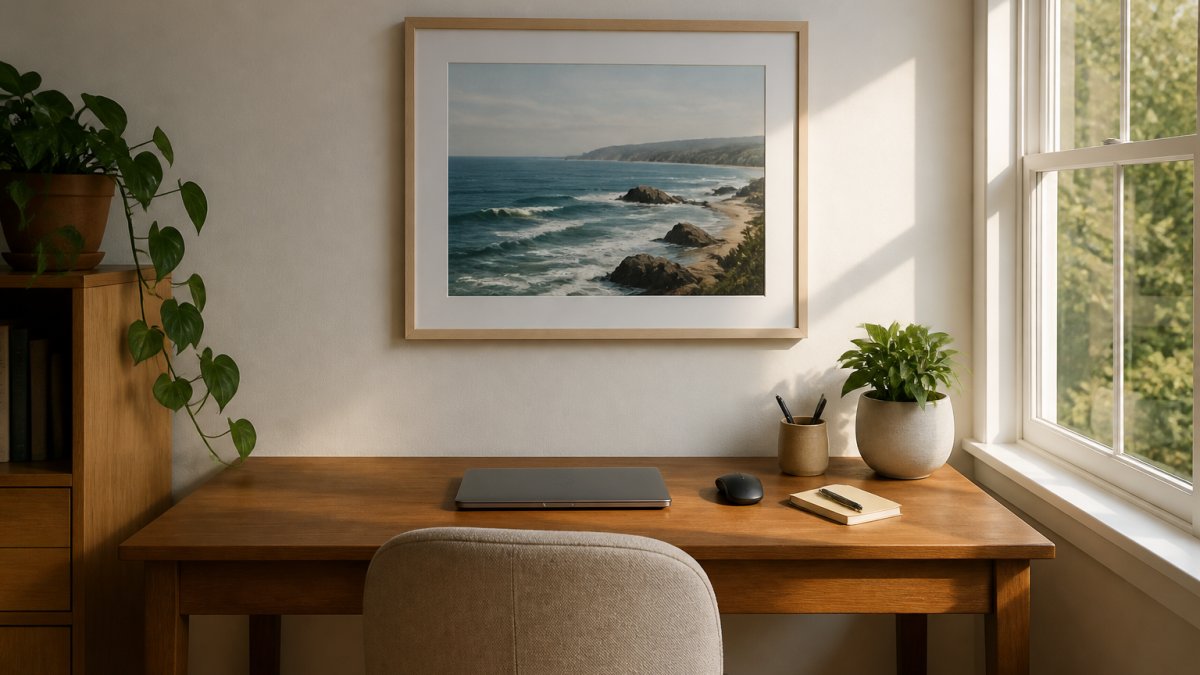
Leave 15 to 25 cm of clear wall between the top of the monitor and the bottom of the frame.
Gallery Wall Layout for a Small Office
A gallery wall layout for a small office works best with three prints, not nine. In a compact room, the choice between one print, a pair and a small trio is a layout decision, not a taste decision, and each option has a different total footprint.
Single, pair or trio: pick by total width
- One print: the simplest and usually the strongest choice for a wall under 90 cm wide. A single 40 × 60 cm print centred on the wall needs roughly 50 to 70 cm of clear width once framed.
- A pair: two 30 × 45 cm prints side by side, with 5 to 8 cm between frames, occupy roughly 70 to 100 cm of wall width. A pair suits a wall above a desk or a low shelf where a single print would look lonely but a trio would feel busy.
- A trio: three 20 × 30 cm prints in a row, or two stacked beside one, occupy roughly 70 to 110 cm. A trio is the maximum most small offices can carry without the wall reading as clutter.
As a rule of thumb, the total width of the group, including gaps and frames, should stay within 60 to 70 per cent of the usable wall width. A 150 cm wall can take a group up to about 100 cm wide; a 100 cm wall should stop at around 70 cm.
Two layouts that suit compact rooms
- The horizontal row: three 20 × 30 cm prints in a line above a shelf, with the bottom edge 20 to 30 cm above the shelf top. Simple, calm, easy to get right, and the safest choice for a low ceiling.
- The column: two or three prints stacked vertically on a narrow wall, with 5 to 8 cm between frames. The column draws the eye upward and makes a low ceiling feel taller, but it needs a wall at least 45 cm wide to avoid looking squeezed.
Pick one anchor, such as the desk edge, the shelf line or the centre of the wall, and build outward from it. Scattered arrangements read as clutter in a room this size.
Renter-friendly hanging for grouped prints
A trio or pair multiplies the number of holes in the wall, which matters if you rent. Three practical options keep the layout light on the wall:
- Adhesive strips rated for the frame weight: most picture-hanging strips are rated per pair, so use two pairs for a 40 × 60 cm frame and check the rating against the combined weight of frame, mat and print.
- A single hanging rail or picture ledge: one set of fixings carries the whole group, and you can slide frames along the rail to adjust spacing without new holes.
- Lightweight frames: a slim timber or metal frame with acrylic glazing weighs noticeably less than a wide moulding with glass, which makes adhesive mounting more reliable.
Whichever method you choose, lay the group out on the floor first and measure the total width and height before you commit. A layout that looks balanced on the floor will look balanced on the wall.
Choosing Your Print Size and Hanging It This Weekend
Start with the wall, not the artwork. If you're weighing canvas against paper for a coastal palette, Canvas Prints vs Fine Art Paper for Coastal Decor compares the two.
Renting? You still have options. How to Display Art in Rented Homes covers renter-friendly display methods.
Your office wall is probably smaller than you think, and that's an advantage. The right-sized print, chosen for the wall rather than the room, makes a compact workspace feel deliberate instead of cramped.
Frequently Asked Questions
What size art print is best for a small office?
For most small offices, a 30 × 45 cm print above the desk or a 40 × 60 cm print on the main wall hits the sweet spot. The right art print sizes depend on wall width: aim for artwork that fills roughly 60 to 70 percent of the wall or furniture width it sits above, leaving breathing room on each side.
How large should art be above a desk?
Art above desk size should generally span about two-thirds of the desk or monitor width, and the bottom edge should sit 15 to 25 cm above the monitor or desk surface. On a 120 cm desk, a 40 × 60 cm or 50 × 70 cm print reads well. A 30 × 45 cm print suits a narrower 90 cm desk without overwhelming the workspace.
Can a large print make a small office look bigger?
Yes, when it is sized to the wall. One generous print, such as 50 × 70 cm or 60 × 90 cm, draws the eye upward and can make a cramped room feel more open than several small pieces scattered across the same wall. The risk is going too large for the available wall space, which crowds the room instead.
Should I choose one large print or a gallery wall for a small office?
One large print usually wins in a small office because it creates a single focal point without visual clutter. A gallery wall layout for a small office works best on a wider wall behind the desk, using three to five matching frames in consistent sizes, spaced 5 to 8 cm apart, and centred at eye level so the arrangement reads as one unit.
How do I measure a wall before buying an art print?
Measure the wall's width and height, then note the width of the desk or shelf below it. Multiply the furniture width by 0.6 to 0.7 to find your target artwork width. Tape paper templates in those dimensions to the wall and step back to check the scale before ordering, and confirm the frame opening matches the print size.
