
Last Updated: October 25, 2026
Quick Summary
Choosing between canvas prints vs fine art paper for coastal decor depends on whether you want texture and a ready-to-hang gallery feel or smooth detail and framing flexibility. Canvas prints arrive stretched and start at $44, while fine art paper prints are unframed, sharper in detail and start at $22.
- Canvas prints are printed on poly-cotton canvas stretched over solid wood stretcher bars and arrive ready to hang.
- Fine art paper holds finer detail because a smooth surface avoids the ink scatter caused by canvas weave.
- For small prints roughly A4 and below, choose paper because canvas weave competes with fine detail.
- A stretched canvas is an open system that lets moisture vapour pass through rather than trapping it.
- An acid-free mount creates an air gap between the artwork and glazing, reducing the risk of sticking.
Table of Contents
- Canvas Prints vs Fine Art Paper: The Quick Comparison
- Texture and Surface Finish: What You Actually See and Touch
- Image Detail, Sharpness and Colour Reproduction
- How to Choose Art Print Finishes for a Coastal Interior
- Salt Air, Humidity and Temperature: How Each Format Copes
- Framed Coastal Art Prints and Presentation Options
- Coastal Wall Art Styling Ideas Room by Room
- Choosing Your Coastal Piece from Pure Art Moments
- Frequently Asked Questions
Canvas Prints vs Fine Art Paper: The Quick Comparison
Choosing between canvas prints vs fine art paper for coastal decor comes down to one question: do you want texture and a ready-to-hang gallery feel, or smooth detail and framing flexibility? At Pure Art Moments, we reproduce our original coastal paintings in both formats, so we can tell you exactly where each one wins.
Canvas prints are printed onto poly-cotton canvas, stretched over solid wood stretcher bars and delivered ready to hang. Fine art paper prints are printed onto smooth, archival-quality matte or luster paper and supplied unframed, ready for you to frame.
Here is the short version:
| Consideration | Canvas Print | Fine Art Paper Print |
|---|---|---|
| Surface | Woven, textured | Smooth or lightly lustrous |
| Arrives | Stretched, ready to hang | Unframed, needs framing |
| Detail | Softened by weave | Crisp, sharp line work |
| Glare | Low reflection | Can reflect near windows |
| Coastal humidity | Stretched, breathable surface | Needs glazing in a frame |
| Starting price | $44 | $22 |
Both formats use the same source artwork. The difference is how you experience it on the wall.
Texture and Surface Finish: What You Actually See and Touch
Texture is the most obvious difference, and it is the one people underestimate before buying. A canvas print has a visible woven surface. Light catches the weave, which softens edges and gives the image a painterly, dimensional quality. Run your hand across it and you feel the grain.
Fine art paper does the opposite. A smooth matte finish, like the 220 gsm acid-free stock we use for the Heron Birds Sunset Art Poster, presents the image as a flat, continuous plane. Nothing interrupts the brushwork.
Neither is higher quality. They are different tools. If you want coastal art prints with texture, canvas is the format that delivers it.
Image Detail, Sharpness and Colour Reproduction
Fine art paper holds finer detail. That is simply how the materials behave. A smooth surface accepts ink without the scatter caused by canvas weave, so crisp lines, delicate tonal shifts and smooth gradients stay intact.
Canvas softens detail slightly, but it gains presence. Large blocks of colour, broad brushstrokes and atmospheric seascapes lose nothing on canvas because there is no fine line work to preserve. Where canvas struggles is with intricate illustration or tight photographic detail at small sizes.
A fair question is whether any print can match an original painting. If that matters to you, read our take on whether art prints look like original paintings before you decide.
How to Choose Art Print Finishes for a Coastal Interior
Start with the image, then the room, then the budget. That order matters. Most buyers pick a finish first and then discover it does not suit the artwork or the wall. A simple decision framework makes the choice much easier.
Step 1: Match the finish to the image.
- Broad, painterly seascapes and abstract work: canvas, almost every time. The weave complements visible brushwork and large blocks of colour, and the texture adds depth that a flat sheet cannot.
- Detailed photography, fine line work and intricate illustration: fine art paper, framed. A smooth surface preserves crisp edges and delicate tonal shifts that canvas weave softens.
- Soft, atmospheric seascapes with subtle gradients: either works, but paper will hold the gradient more cleanly; canvas will make it feel more painterly.
- Small prints (roughly A4 and below): paper, because canvas weave competes with fine detail at small sizes.
- Large statement pieces (roughly 60x90 cm and above): canvas, because it fills a wall with presence and needs no glazing.
Step 2: Match the finish to the room and viewing distance.
Viewing distance decides the rest. From across a living room, texture and colour impact matter more than sharpness. Close up in a hallway, detail wins.
- Living rooms: one large canvas as a statement piece above the sofa, roughly two-thirds the width of the furniture below it. Add a smaller framed print on an adjacent shelf for depth.
- Bedrooms: a muted matte canvas above the bedhead, or a framed paper print if the palette is soft and detailed.
- Hallways and entryways: paper prints in slim frames fill narrow vertical walls that a canvas would crowd.
- High-traffic hallways and family rooms: stretched canvas, which needs no glass to protect it and wipes clean with a dry brush.
- Bright rooms with direct sun: canvas, because it reflects far less light; if you choose paper, plan for UV-filtering glazing and a spot out of direct sun.
- Gallery walls: paper prints, because matched frames create visual rhythm and let you mix sizes economically.
- Rental properties: smaller paper prints are easier to hang, move and replace; leaning a framed print on a sideboard avoids drilling altogether.
Step 3: Budget for the whole cost, not just the print.
A paper print's sticker price is only part of the outlay. Framing, glazing, a mount and backing board can add more than the print itself, and shipping framed art costs more than shipping a stretched canvas.
For a deeper look at how to choose art print finishes that suit your space, our canvas range covers thirteen sizes from 8x8 up to 37x37 inches, and the same artworks are available on paper if you prefer to frame.

Salt Air, Humidity and Temperature: How Each Format Copes
Coastal homes are harder on art than inland ones. Salt air, humidity swings and strong sunlight all take a toll, and the two formats respond differently. Most guides stop at 'canvas is breathable, paper needs framing'.
Wave Textured Painting Canvas Print | Gallery-Quality Coastal Wall Art | 13 →
How canvas copes. A stretched canvas is an open system. The poly-cotton weave sits over a timber stretcher frame with no glass and no backing board, so moisture vapour passes through rather than being trapped.
How paper copes. A paper print is a closed system once framed, and its performance depends almost entirely on what you put around it.
Frame and glazing materials matter more than most buyers expect. Timber frames move with humidity; a well-sealed frame with a moisture-resistant backing is more stable than an open-backed one. Acrylic glazing is lighter and less prone to shattering than glass, which matters in a holiday rental, but it scratches more easily. Neither glass nor acrylic stops fading on its own; UV-filtering glazing slows it, but it does not replace keeping art out of direct sun.
Temperature swings. Rapid temperature changes are more damaging than steady warmth or cool.
Framed Coastal Art Prints and Presentation Options
Canvas arrives as a finished object. Our stretched canvases include mounting brackets, so the piece goes straight onto the wall with no extra spend. A floating frame can be added later if you want a more formal, gallery-style presentation, though the stretched edge already reads as complete.
Paper prints are a blank canvas in the other sense: you choose the frame, and the frame changes the piece. Timber suits warm sunset palettes. White keeps things light and breezy. Black adds contrast to pale coastal walls.
Budget for framing honestly. A $24 print in a quality frame can cost more than a mid-sized canvas, and that is fine, because you get to control the look. For practical guidance, see our framing tips for fine art prints before you order moulding.
Coastal Wall Art Styling Ideas Room by Room
Living rooms suit one large canvas as a statement piece above the sofa, roughly two-thirds the width of the furniture below it.
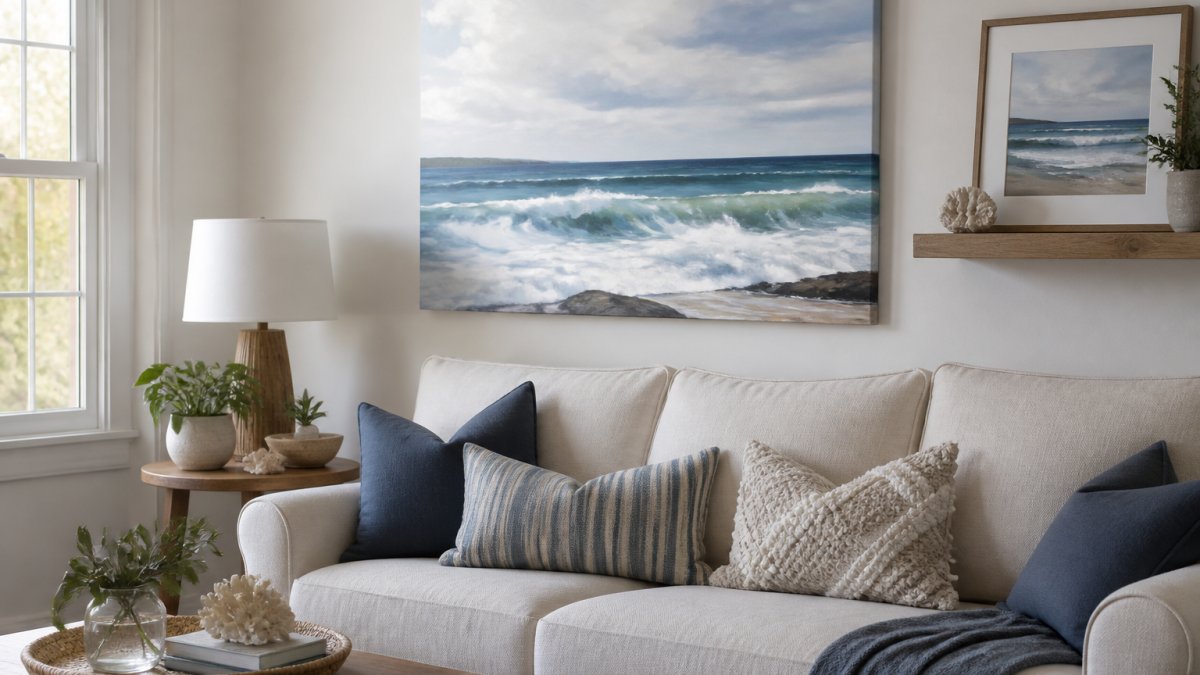
Bedrooms want calm. A muted matte canvas, like our Heron Sunset Canvas Wall Art, works above a bedhead without competing with linen and timber.
Hallways and entryways are where paper prints earn their keep. A narrow vertical print in a slim frame fills a tight wall that a canvas would crowd.
Rentals benefit from leaning rather than hanging: a framed print on a sideboard or shelf needs no drill and no permanent change.
For coastal wall art styling ideas across the whole home, mix one canvas with two or three paper prints in matching frames. The contrast in surface keeps a gallery wall from looking flat.

Choosing Your Coastal Piece from Pure Art Moments
Our recommendation is simple. If you want one piece, hung in an afternoon, that fills a wall with texture and colour, choose canvas. If you want control over framing, sharper detail, or a smaller piece for a rental or gallery wall, choose paper.
Both come from the same originals, painted by hand in our studio on the Bellarine Peninsula and reproduced to hold the depth and colour of the source work. Start with the wave textured canvas print in thirteen sizes from $44, or compare it against the wave textured art print on premium luster paper from $24. Same artwork, two very different walls.
Frequently Asked Questions
What is better, fine art paper or canvas?
Neither is universally better; they suit different jobs. Fine art paper gives crisp detail and smooth gradients, which suits photographic seascapes and tightly framed gallery walls. Canvas prints bring texture, a soft relaxed look and ready-to-hang convenience, which suits statement pieces in living rooms. Both formats in the Pure Art Moments range use archival materials, so the decision comes down to the look you want and where the piece will hang.
Are canvas prints cheap looking?
Cheap-looking canvas usually comes down to thin stretcher bars, a loose stretch and low-resolution printing. A well-made canvas print is a different object: the Wave Textured Painting Canvas Print uses 344 g/m² poly-cotton canvas stretched over solid wood bars at 3.18 cm deep, with mounting brackets included. At that weight and depth it reads as a gallery piece rather than a poster on a frame.
Should fine art paper prints be framed for coastal decor?
Yes, in most coastal rooms. Unframed paper is vulnerable to humidity, dust and accidental marks, and a frame with glazing adds a barrier against salt air. Timber, white or black frames all work with coastal palettes. Our fine art prints are supplied unframed, so budget for framing when comparing costs: a $43 Point Lonsdale Rock Pools Sunset Fine Art Print plus a frame can land close to the price of a ready-to-hang canvas.
How do canvas and fine art paper affect the look of coastal artwork?
Canvas softens edges slightly and adds visible weave, which suits loose wave paintings and abstract seascapes. Paper holds fine detail and smooth tonal shifts, so sunset gradients and rock pool reflections stay sharp. In a coastal interior, canvas tends to feel warmer and more casual, while framed paper reads more formal and gallery-like. Match the format to the painting style rather than picking one for the whole house.
Which finish works best for coastal landscape prints?
For large, painterly coastal landscapes, a matte stretched canvas usually wins because the texture echoes the brushwork. For photographic beach scenes and detailed rock pool shots, a smooth matte or luster fine art paper holds the detail better. Avoid high-gloss finishes near windows, where glare from natural light washes out the image and spoils the view from the sofa.
The hardest part is not choosing a format. It is choosing which piece goes where. If you are weighing up a statement canvas against a collection of framed prints, we can help you match the right reproduction to the right room, and if you want to go further, you can book an experience and see the original work behind every print. Get started with Pure Art Moments and bring a little coastal calm onto your walls.
