
Table of Contents
- The Difference Between Hand-Painted Art and Prints
- Uniqueness and One-of-a-Kind Quality
- How to Tell If Art Is Hand-Painted
- The Emotional Connection and Personal Meaning
- How to Choose Original Art for Your Space
- Caring for Canvas Paintings and Preserving Your Investment
- Supporting Artists and Sustainable Choices
- Frequently Asked Questions
Last Updated: October 5, 2026
The Difference Between Hand-Painted Art and Prints
Hand-painted art and prints are fundamentally different products, even with the same design. A hand-painted work is created directly by an artist's hand on canvas, each brushstroke intentional. Prints are mechanical or digital reproductions that lack the artist's direct involvement.
This distinction changes what you're buying. Hand-painted art carries the artist's energy into your space; a print is a copy, however high-quality. At Pure Art Moments, we work with original hand-painted pieces created in our studio, then reproduce them to preserve that texture and depth.
The texture of hand-painted work is visible and tangible: paint has depth and catches light differently depending on the angle. Prints are flat by nature, even premium canvas reproductions lack the dimensional quality of brushwork.
The creation process also differs. A hand-painted piece takes time, with the artist responding to how colours interact and the composition develops. Prints are duplicated identically, so every copy of a design is the same. Hand-painted works are never truly identical, even when the artist paints the same subject twice.
Uniqueness and One-of-a-Kind Quality
When you buy hand-painted art, you own something that exists nowhere else. No two pieces are exactly alike, even the same scene painted twice shows subtle differences in light, mood, and brushwork.
This uniqueness has real value: you can't find an identical version for less or see the same piece in another home. That exclusivity matters to people who want their spaces to reflect individual taste, not mass-market trends.
Prints are mass-produced, thousands of copies can be made from one design. That makes them affordable, but your print is one of many hanging in multiple homes.
Hand-painted art also develops character: colours shift subtly as paint ages, and the surface records how the piece has been cared for. Prints remain static and develop no patina.
How to Tell If Art Is Hand-Painted
Telling a genuine hand-painted piece from a reproduction takes a structured inspection. Work through a practical checklist covering brushwork, materials, provenance, and the artist's credentials, the step most online guides skip.
1. Examine the brushwork up close
Hand-painted work shows the artist's hand: visible brushstrokes, ridges where paint was applied thickly, and slight variations in coverage. Under raking light, hold a lamp to one side, the surface reveals texture and directionality. A print, even a high-quality giclée, sits flat because ink is applied uniformly. Some reproductions use clear gel medium to mimic brushwork, so check whether the texture follows the painted shapes; mechanical ridges mean a reproduction.
2. Check the materials and the support
Ask what the work is painted on and with. Oil on linen, acrylic on cotton canvas, and watercolour on cotton rag all age differently. A hand-painted canvas usually shows the priming layer and may have paint wrapping over the tacking edges, while prints often have a clear border where the image stops short of the fold. Check the back: a hand-painted canvas may show pencil marks, studio stamps, or a signature and date; a print typically has a smooth, unmarked reverse.
3. Verify provenance and documentation
Provenance is the documented history of the piece. For a living artist, a signed certificate of authenticity (COA) is the standard record: artist's name, title, medium, dimensions, year, and ideally a unique identifier. Keep the receipt, COA, and correspondence together, and ask for original documentation when buying second-hand. A missing COA isn't automatically a red flag, but it affects resale and insurance.
4. Assess the artist's credentials and process
A hand-painted work is only as meaningful as the artist behind it. Look for a consistent body of work, exhibition history, gallery representation, or a verifiable studio practice. Ask how the piece was made, from life, a photograph, or a sketch, how long it took, and what references were used. Artists who work directly with buyers are usually happy to answer; evasive answers are a signal to slow down.
5. Use a simple in-person test
If you can handle the piece, run these checks in order:
- Tilt the surface under a light and look for brush texture that follows the image.
- Run a fingertip lightly across a discreet corner, hand-painted work feels uneven; prints feel uniform.
- Inspect the edges: paint on the sides suggests the artist worked across the whole surface.
- Look for natural imperfections: slight colour bleeding, visible pencil underdrawing, or a signature that sits under the varnish.
- Compare the colour across the surface: hand-mixed paint shows subtle variation; digital prints are perfectly consistent.
No single test is conclusive. The strongest signal is a combination: image-following brushwork, appropriate materials, documented provenance, and a verifiable artist. When those line up, you can be confident the piece is genuinely hand-painted.
The Emotional Connection and Personal Meaning
Hand-painted art creates emotional resonance that prints often don't. Knowing an artist's hand created the work feels different, someone made deliberate decisions about colour, composition, and technique for this piece, and that intentionality creates connection.
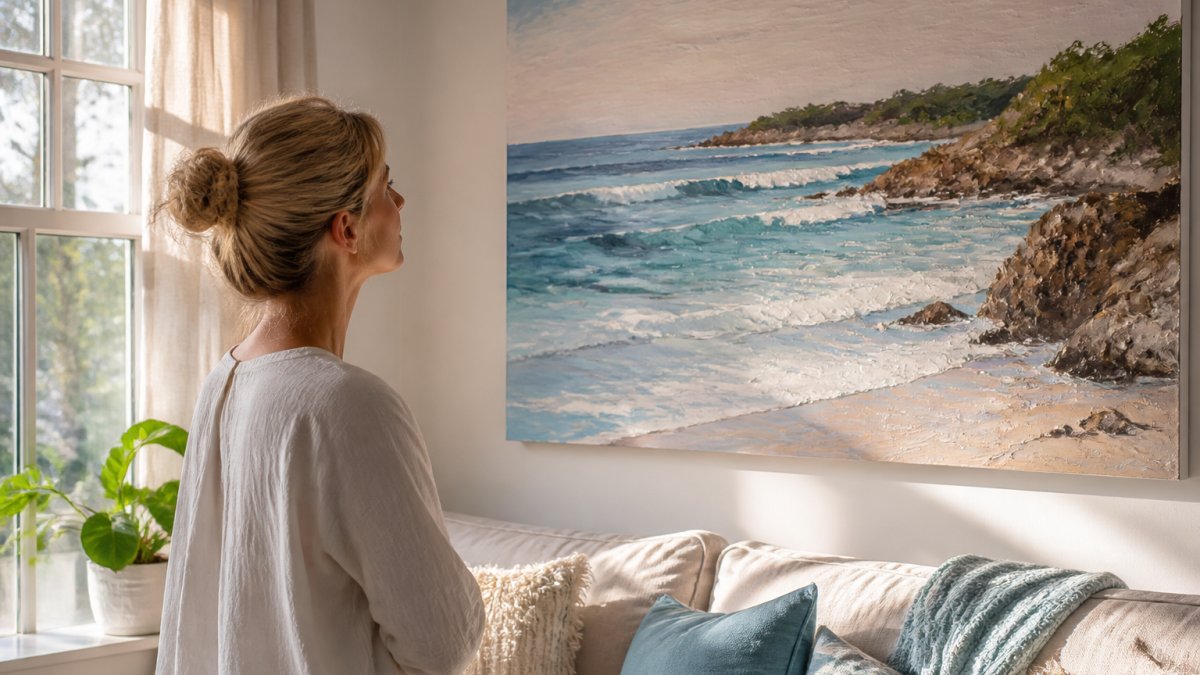
Many people find hand-painted art speaks to them more deeply than reproductions. The work carries the artist's vision directly, you're looking at the vision itself, not a copy, and that directness invites fuller engagement.
Personal meaning also builds when art is commissioned. A print can never offer this personalisation.
Hand-painted art also makes a meaningful gift. A coastal scene recalling a special holiday, or an abstract matching someone's aesthetic carries weight because it's one-of-a-kind, chosen for the recipient rather than mass-produced.
How to Choose Original Art for Your Space
Selecting hand-painted art requires thinking about colour, scale, and how the piece fits your décor. Identify the colours already in your space, walls, furniture, dominant tones.
Consider scale: a small artwork gets lost on a large wall, while a large piece overwhelms a compact room. Measure your wall space before committing, and think about sight lines, where people naturally look on entering is often the ideal spot.
Think about the mood you want. Coastal-inspired art brings calm, abstract pieces add energy, and figurative work creates focal points. Match the art's mood to the mood you want in that space.
Evaluate the lighting. Hand-painted art with texture looks best in natural light, which catches the brushwork and shows depth; poor lighting flattens it. If natural light is limited, place the art where lamps can illuminate it.
Visit galleries or view work online before deciding, and live with the image in your mind for a few days. Impulse art purchases often disappoint; taking time leads to pieces you'll love long-term.
Caring for Canvas Paintings and Preserving Your Investment
A hand-painted canvas can last for generations if the materials were sound and the piece is cared for correctly. Here's what to look for at purchase, how to frame and hang it, and how to clean and store it without damage.
Start with quality at the point of purchase
Durability begins with the artist's materials. Oil on linen or cotton canvas, properly primed and varnished, is among the most stable supports. Acrylic on canvas is durable but attracts dust; watercolour on paper is vulnerable to light and moisture and should be framed behind glass. Ask what medium, support, and varnish were used; a well-finished piece usually has a removable varnish layer a conservator can replace later.
Frame and hang it correctly
A canvas with a finished edge can hang unframed, but most buyers choose a frame for protection and presentation. Use acid-free mounting materials, standard cardboard and some adhesives yellow paper and damage canvas. For works on paper, specify UV-filtering glass or acrylic; for canvas, a floater frame or one with a rabbet deep enough to avoid pressing on the paint is ideal.
Hang the piece away from direct sunlight, since UV light fades pigments and yellows varnish. If a sunlit wall is the only option, use UV-filtering glazing or rotate the piece periodically. Avoid heat sources such as fireplaces or radiators, and damp walls, which cause mould and distortion.
Clean gently and rarely
Dust is the main enemy of a canvas in a normal home. Use a soft, dry, clean brush, a wide makeup brush or art duster works well, and brush the surface lightly every few months. Never use water, household cleaners, or solvents, since moisture can penetrate the canvas and cause mould or paint loss. If the surface is tacky or marked, consult a conservator.
Control the environment
Aim for stable, moderate conditions. Rapid swings in temperature and humidity make canvas expand and contract, causing cracking or warping; most homes sit comfortably between 40 and 60 per cent relative humidity. Avoid bathrooms, kitchens, or uninsulated garages where humidity spikes. In extreme climates, keep the piece on an interior wall and consider a dehumidifier during wet months.
Store and transport safely
If you take a piece off the wall, wrap it in acid-free paper or a clean cotton sheet, never bubble wrap against the paint, which can leave impressions. Store canvases upright, never flat or rolled, in a dry, climate-controlled space; store works on paper flat in an acid-free box. When moving, transport framed works in a crate or padded box and carry canvases by the frame, not the stretcher bars.
Document and insure
Keep a record of every significant piece: photographs, dimensions, medium, artist's name, purchase date, and the certificate of authenticity. This supports insurance claims and establishes provenance if you sell or lend the work. Add valuable pieces to your home contents insurance and review cover every few years. If a piece is damaged, contact a conservator before attempting repairs.
With sensible care, a hand-painted canvas will outlast most furniture in the room. The goal isn't to treat it as fragile, but to avoid the handful of conditions, direct sun, moisture, heat, and harsh cleaning, that cause most avoidable damage.
Supporting Artists and Sustainable Choices
Buying hand-painted art directly supports the artist.
Supporting artists matters for culture and creativity. Artists who earn fair income can keep creating, invest in better materials, develop their skills, and take time on meaningful work instead of rushing commissions. Your purchase enables this.
Hand-painted art is also more sustainable than mass-produced alternatives. Each piece is made intentionally, with no overproduction or waste, the artist creates what's needed, not excess inventory destined for landfills.
Choosing work from local or independent artists strengthens creative communities. You're investing in human creativity rather than corporate production, and supporting people who have dedicated their lives to making beautiful things.
When you buy from Pure Art Moments, you're supporting artist Pam Colla directly.
Choosing hand-painted art transforms how you experience your space. Original artwork brings texture, uniqueness, and emotional depth that prints cannot match. It connects you to the artist's vision and supports creative work that enriches culture.
Frequently Asked Questions
Why choose hand-painted art over a print?
Hand-painted art offers authenticity, visible brushwork, and texture that prints cannot replicate. Each piece captures the artist's unique technique and creative vision. Original artwork holds emotional significance and often appreciates in value, while prints are mass-produced and lack the depth and character of hand-painted work. Hand-painted pieces also create a stronger connection to the artist's intent and craftsmanship.
How can you tell if a painting is hand-painted?
Look for visible brushstrokes, colour variations, and texture across the surface. Hand-painted art shows inconsistencies in application that reflect the artist's process. Examine the edges and corners for imperfections, layered paint, and dimensional quality. Prints, by contrast, appear uniform and flat. Ask the artist or seller about their technique, materials, and process. Authentic hand-painted work often comes with documentation of the artist's credentials and studio practice.
How do you care for a hand-painted canvas?
Keep paintings away from direct sunlight, extreme heat, and moisture, which can fade colours and damage the canvas. Dust gently with a soft, dry cloth, avoid water or cleaning products. Hang artwork in stable environments away from kitchens and bathrooms. Use UV-protective glass or acrylic for framing if displayed near windows. Store unframed pieces flat in a cool, dry space. For valuable pieces, consider professional conservation advice. Proper care preserves the integrity and longevity of your investment.
Is hand-painted art worth the investment?
Hand-painted art is worth the investment because it combines aesthetic value, emotional meaning, and potential financial appreciation. Unlike mass-produced prints that lose appeal over time, original artwork deepens your connection to your space and often increases in value. You're supporting the artist's livelihood and craftsmanship. Hand-painted pieces become meaningful heirlooms and conversation starters. The durability, uniqueness, and personal resonance make them a worthwhile choice for those seeking art that truly transforms their environment.