
Table of Contents
- What Sacred Flow Art Sessions Actually Involve
- How to Enter a Flow State Through Movement
- Flow Arts for Mental Health: What Changes in the Brain and Body
- Beginner Flow Arts Equipment Guide: What You Need Before Your First Session
- Injury Prevention and Ergonomics for Safe Practice
- Bringing Sacred Flow Art into Daily Life
- Frequently Asked Questions
Last Updated: September 30, 2026
What Sacred Flow Art Sessions Actually Involve
Sacred flow art sessions combine two things: rhythmic prop movement and mindful creative practice. You move an object, such as fabric, a hoop or a staff, in repeating patterns while staying present. Then you bring that same focus to a canvas or page.
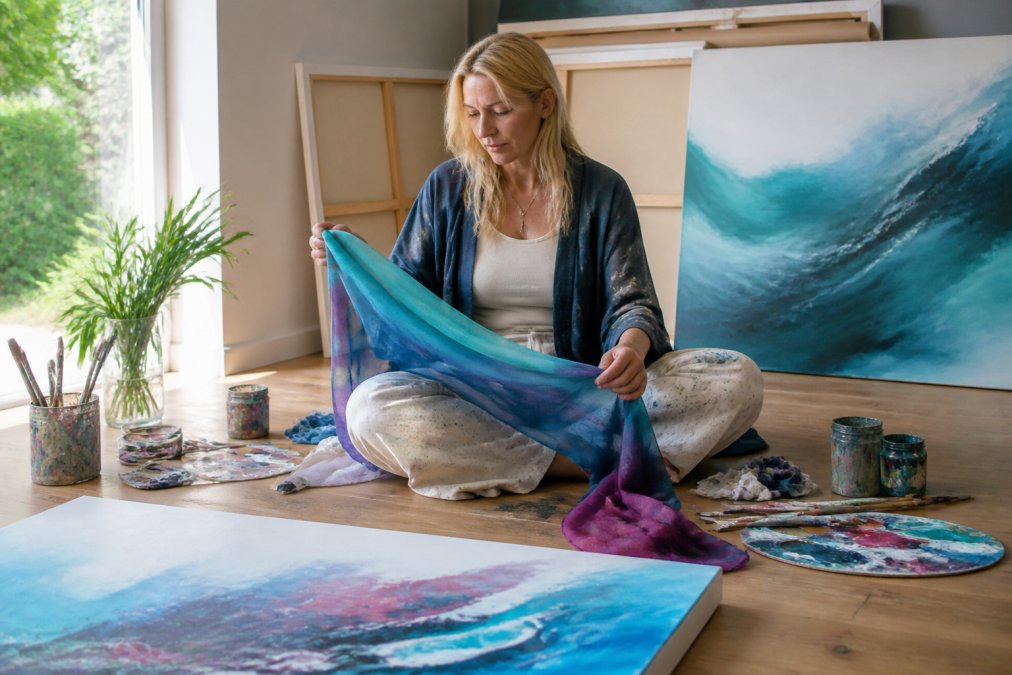
This guide from Pure Art Moments breaks down the benefits of sacred flow art sessions, from the physical to the emotional. We host Untamed Canvas sessions built around exactly this mix of movement and art.
Flow arts is an umbrella term for movement disciplines that use props.
The difference between flow arts and creative arts therapy
Flow arts is a movement practice. Creative arts therapy is a facilitated, therapeutic process led by a trained practitioner.
How to Enter a Flow State Through Movement
Learning how to enter a flow state through movement starts with repetition, not talent. Flow arrives when the task is hard enough to hold your attention but easy enough to keep going.
Here is a simple sequence for your first session:
- Set up in a clear space with room to move your arms.
- Warm up your wrists, shoulders and neck for two minutes.
- Pick one prop and one basic move. Just one.
- Repeat that move slowly for five minutes without stopping.
- Speed up only when the move feels automatic.
- Add a second move and link the two.
- Finish with two minutes of stillness and slow breathing.
A step-by-step sequence for your first session
Total time: 25-30 minutes Difficulty: Beginner
What you'll need:
- One prop (a light hoop or soft fabric works well)
- A clear space of about two square metres
- Water
- A journal or sketchbook for afterwards
The goal of session one is not a trick. It is the feeling of losing track of time. That feeling is the flow state, and it shows up faster than most people expect.
Flow Arts for Mental Health: What Changes in the Brain and Body
Flow arts for mental health works on two fronts at once. The movement releases tension and lifts mood, while the focus on a single task quiets the mental chatter that feeds anxiety. But what actually happens in the brain during a flow state? Understanding the neurobiology helps explain why the practice feels so restorative, and why it is more than just a distraction.
The neuroscience of flow: dopamine, norepinephrine and endorphins
When you enter a flow state, the brain shifts into a mode that researchers describe as transient hypofrontality, a temporary quieting of the prefrontal cortex, the area responsible for self-criticism and time monitoring. This is why hours can feel like minutes and why you stop second-guessing every move.
- Dopamine, drives motivation and reward, making the repetition feel pleasurable rather than tedious.
- Norepinephrine, sharpens attention and keeps you locked on the task.
- Endorphins, natural painkillers that produce the mild euphoria many practitioners report after a session.
- Anandamide, an endocannabinoid linked to the 'runner's high' and a sense of calm alertness.
Stress reduction, mood, and emotional regulation
The stress reduction effect comes from a few things happening together:
- Steady breathing while you move
- A single point of focus instead of scattered thoughts
- Gentle physical exertion, which supports endorphin release
- A sense of progress as a move clicks into place
What the research says about meditative movement
Research into meditative movement, a category that includes tai chi, qigong and flow arts, suggests that rhythmic, repetitive activity supports emotional regulation and mental clarity. The Black Dog Institute's resources on movement and mood outline how regular physical activity supports mental wellbeing, and a 2021 study in Mindfulness found that flow states during movement predicted lower anxiety and higher life satisfaction.
Beginner Flow Arts Equipment Guide: What You Need Before Your First Session
The best beginner flow arts equipment is light, cheap and forgiving. You do not need a full kit to start.
| Item | Why You Need It | Rough Priority |
|---|---|---|
| Soft fabric or light hoop | Easiest prop for first moves | Essential |
| Yoga mat or rug | Cushions feet and knees | Essential |
| Water bottle | Sessions run 20-30 minutes | Essential |
| Sketchbook | Captures how you felt after | Useful |
| Wrist wraps | Support during longer sessions | Optional |
| Heavier props | Build strength once basics are solid | Later |
Injury Prevention and Ergonomics for Safe Practice
Most flow arts injuries come from doing too much too soon. Wrists, shoulders and lower back take the brunt. But the risk is not just about volume, it is also about how you hold and move the prop. Ergonomics matters as much in flow arts as it does at a desk.
Common injuries and why they happen
Flow arts involve repetitive motion, often with one arm dominating. The most frequent complaints are:
- Wrist tendonitis, from gripping a hoop or staff too tightly and flicking the wrist repeatedly.
- Shoulder impingement, from overhead moves without adequate rotator cuff strength.
- Lower back strain, from bending at the waist instead of hinging at the hips.
- Elbow pain, from locking the arm during fast spins.
Prop ergonomics: choosing and holding your equipment
The way you hold a prop determines how much strain reaches your joints. For poi, the loop should sit loosely around your middle finger, not tight against the base. For hoops, a lighter hoop (around 100-120 cm in diameter for beginners) spins slower and gives you more time to react without muscling it. Staffs should be gripped lightly, with the thumb and forefinger guiding rather than clenching.
A safe warm-up and cool-down routine
Follow these rules to keep practising for years:
- Warm up for at least two minutes before every session, arm circles, wrist rolls, neck turns and hip hinges.
- Keep your knees soft, not locked.
- Stop when a joint aches, not when it hurts.
- Alternate sides so one arm does not do all the work.
- Keep your props light until your form is solid.
- Stretch your wrists and forearms afterwards.
The Australian Physiotherapy Association recommends building load gradually and warming up before repetitive movement. A useful guideline is the 10% rule: increase your session time or prop weight by no more than 10% per week. Sessions of 20 to 30 minutes, three times a week, are plenty for beginners.
Load management and recovery
Your tendons and ligaments adapt slower than your muscles. That is why you can feel strong enough to practise daily but still develop overuse pain. Build in at least one rest day between sessions, and if you feel a niggle, take two. Recovery is not laziness, it is when the tissue actually gets stronger.
Bringing Sacred Flow Art into Daily Life
The real payoff comes when the practice stops being a scheduled event. You can bring the same focus into small moments of your day.
Try these:
- Five minutes of prop movement before your morning coffee
- A short breathing pause before a difficult meeting
- Doodling or painting for ten minutes after work
- A weekend session with a friend instead of scrolling
Frequently Asked Questions
What are the mental health benefits of flow arts?
Flow arts combine rhythmic movement with focused attention, which can reduce stress and improve mood. The repetitive motion of prop manipulation supports mindfulness and emotional regulation, while the challenge of learning new skills builds confidence. Many people find that sacred flow art sessions offer a moving meditation that quietens mental chatter and creates a sense of clarity.
What equipment is needed for a sacred flow art session?
You do not need much to begin. A beginner flow arts equipment guide suggests starting with a lightweight prop. Comfortable clothing and a clear space of about two metres square are enough. Some people also like a yoga mat for floor-based warm-ups. As you progress, you can add props that suit your preferred style.
Can flow arts be considered a form of moving meditation?
Yes. The repetitive, rhythmic nature of prop movement draws your attention to the present moment, similar to traditional meditation. When you focus on the sensation of the prop in your hands and the flow of your breath, your mind settles. This is why flow arts for mental health are often described as active meditation, offering the calming benefits of mindfulness without sitting still.
How do I begin a sacred flow art practice at home?
Start with a short daily session of five to ten minutes. Choose a prop that feels comfortable and clear a small space. Follow a simple sequence: warm up your wrists and shoulders, practise a basic movement pattern slowly, then let the rhythm guide you. Consistency matters more than duration. Over time, you can extend your sessions and explore more complex movements, letting the practice become a regular part of your routine.
Life gets loud. Between work, family and the endless pull of screens, finding a practice that settles both body and mind is rare. Pure Art Moments offers Untamed Canvas Sacred Flow Sessions, original coastal artwork by Pam Colla, and creative arts therapy for people navigating anxiety, grief and major life change. Book an experience and see how movement and art can change your day.